
Broken Rejected Mate
Basic information
Broken Rejected Mate is credited to Caroline Stark and is listed as a novel in the Luna Wolf series. A bibliographic listing dates the work to 2022. Available catalog and retailer material places it within werewolf or shifter romance, a form of paranormal romance built around supernatural communities, fated relationships, and emotionally heightened conflict. The record is incomplete: it does not securely identify a publisher, a precise first-publication date, or a complete edition history. Related listings use titles such as Rejected and Damaged and Broken and Rejected, so the title appears in slightly different forms across reading platforms. The safest description is therefore a 2022-listed Luna Wolf romance novel whose public availability has chiefly been documented through digital and genre-fiction listings.
Plot and central conflict
The narrator has grown up surrounded by war and believes that experience has made her unbreakable. That confidence collapses when her fated mate turns out to be an enemy who rejects her. In the society represented by the synopsis, rejecting one’s mate is taboo and traditionally carries a deadly cost. The male mate, however, does not care about the expected punishment. His priorities are his pack and his betrothed, leaving the narrator feeling like an unwanted inconvenience rather than a person bound to him by fate.
The rejection is intensified by inherited hostility. The betrothed carries the blood of the woman who murdered the narrator’s mother, and that bloodline is identified as one of the causes of the war. The male protagonist also despises the narrator because she is a rogue, a member of the kind he has been taught to hate. She returns that hatred toward his people, yet her heart continues to respond to him. Her dilemma is consequently both romantic and political: she must decide whether to fight for the love fate seems to promise or remain loyal to her father and her own side.
The synopsis presents two men whom the narrator loves as determined to destroy each other. Both want war, and she is trapped between them. This structure makes the heroine an emotional and ethical intermediary between rival families or communities. The available excerpt ends before the conflict is resolved, so the ending, the final loyalties, and any reconciliation cannot be stated as established facts.
Themes, context, and status
The novel’s defining theme is the tension between destiny and agency. A fated mate is supposed to make love inevitable, but rejection demonstrates that social allegiance and individual will can resist the supernatural bond. The story consequently treats romance as a question of choice rather than merely recognition. Rejection is at once an intimate wound and a challenge to the laws of the wolf society, since it threatens customs that connect partnership, loyalty, punishment, and survival.
Identity and exclusion form a second major concern. The heroine’s status as a rogue marks her as an outsider, while her mother’s murder and her father’s position give her a personal stake in the war. She is not simply searching for acceptance: she is also carrying a history of grief and resentment that makes acceptance morally complicated. The betrothed’s ancestry shows how collective violence is transmitted through families, even when individuals did not commit the original crime. In this way, the romance places private desire inside a wider struggle over bloodline, belonging, and inherited blame.
The surviving synopsis suggests a first-person, emotionally immediate style. Its key images—wolf packs, a forbidden rejection, a hostile mate, a dangerous betrothal, and a heroine caught between war and family—belong to the high-conflict conventions of shifter romance. No reliable source describes the circumstances in which Stark wrote this novel, and there is no documented evidence in the supplied material of a major adaptation, broad critical movement, or established canonical influence. Its confirmed status is that of a listed series romance circulating through online bookselling and reading services. Its continuing appeal within that context lies in combining the recognizable fantasy of a fated bond with the sharper drama of refusing, surviving, and possibly redefining the social world that bond is meant to govern.
About the Author
Identity and education
The reliable biographical material identifies Caroline Stark as a classicist affiliated with Howard University, where profiles describe her as an assistant professor or associate professor of Classics. Her education took her through several institutions and disciplines. She earned a BA in Latin from Sweet Briar College, then completed an MA in Cultural and Intellectual History, 1300–1650, at the Warburg Institute of the University of London. At Yale University she pursued Classics and Renaissance Studies and received an MA, an MPhil, and a PhD. The available profiles do not state her birthplace, birth date, family background, or early life, so those details cannot be supplied without confusing her with other people who share the name.
Her scholarly interests include ancient cosmology, anthropology, ethnography, and the reception of classical antiquity. She studies not only Greek and Roman antiquity itself, but also the ways later societies interpret, transform, and contest classical traditions. Her stated geographical and cultural range includes medieval and Renaissance Europe, Africa, and the African diaspora. This places her work at the intersection of Classics, intellectual history, literature, art history, and cultural studies.
Projects and major scholarly work
Stark is the creator of the Io Project, an online resource devoted to the history and reception of Classics in Africa and the African diaspora. The project is designed as a gateway for scholars, teachers, students, and the public, bringing African and diasporic art, literature, and scholarship into dialogue with the ancient Mediterranean. The project is particularly important as a public-facing intervention: it broadens the map of classical reception beyond the settings most traditionally emphasized in classical scholarship.
Her academic appointments also include a visiting faculty fellowship at Duke University through the Humanities Writ Large program in 2016–2017. During that period, the Io Project was one of the projects associated with her work there. She has also been co-editing, with Lee Fratantuono, A Companion to Latin Epic 14–96 CE for Wiley-Blackwell. The supplied material does not give a confirmed publication year for that volume. In addition, she has been working on a book about Africana receptions of classical heroines and another project examining the intersection of humanism, philosophy, art, and related fields. These projects are documented as works in progress, not as completed books with established publication dates.
The novelist attribution and reputation
Book listings credit Caroline Stark with Broken Rejected Mate, a 2022-listed novel in the Luna Wolf series. The supplied evidence does not establish whether the novelist and the Howard University classicist are the same person, nor does it provide an author website, interview, or publisher biography resolving the question. A responsible biography must therefore keep the literary attribution separate from the academic record rather than inventing a shared career narrative.
There is likewise no reliable death date or death account for the scholar described in the university profiles. A social-media notice about a Caroline’s death concerns an unidentified retired employee and cannot be used as evidence about this author or classicist. On the evidence available, Stark’s lasting reputation is chiefly academic: she is associated with research on classical reception across cultures and with making African and diasporic engagements with Classics more visible through the Io Project. A complete publication list, a confirmed chronology of major books, and information about her later life remain undocumented in the supplied material.
StoryFlow
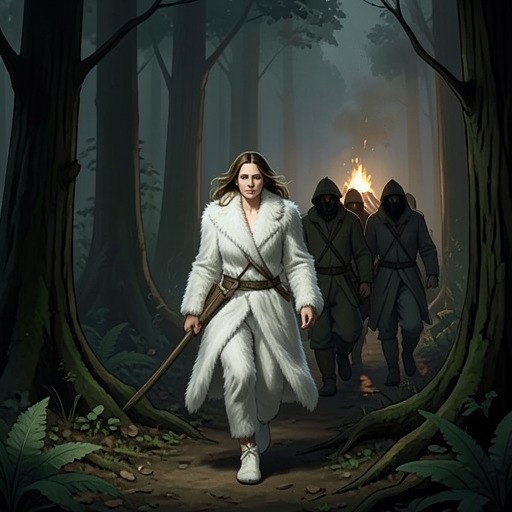
Sierra’s Flight Toward Belonging
This flow traces Sierra’s movement from perpetual concealment toward a chosen home and community.

Alan’s Rise to Leadership
This flow follows Alan from restless heir to a compassionate Alpha who inherits power without repeating Ronald’s crimes.

Sierra and Alan’s Mate Bond
This flow traces the relationship from instant recognition and rejection to mutual love and permanent union.
